A Travelling Spirit: The Journeys Within While the Green Grass Grows

Director Peter Mettler discusses his seven-part documentary epic While the Green Grass Grows and its exploration of life, place, family, and time. The post A Travelling Spirit: The Journeys Within While the Green Grass Grows appeared first on POV Magazine.
A road film that travels down nocturnal highways, churning waterfalls, rocky mountains, dank caves, languid rivers and the bluest of oceans, Peter Mettler’s While the Green Grass Grows is a myriad of delights and contradictions that is bound to impress and confound film viewers. At seven hours, his self- styled film diary in naturally—seven parts will challenge audiences to engage in its daring content for a Wagnerian length. Those who are up for the task will be rewarded with an engaging if digressive account of the filmmaker’s ongoing quest for meaning while dealing with the deaths of his parents and his own fight to remain alive.
Made in the era of the pandemic, it is arguably the best depiction of life during COVID currently extant. The film is beautifully shot by Mettler, who has been the cinematographer for Atom Egoyan, Patricia Rozema and Jennifer Baichwal. His personal epic takes us from Ontario to New Mexico and Manitoba to Switzerland as he follows the dreams and realities of a disparate but appealing roster of characters. Chief among them is his steadfast, resolutely logical Swiss father Freddy, who deals with the death of his beloved wife Julia in a quietly decorous manner.
While the Green Grass Grows straddles two unique genres, the film diary and the essay. Mettler was clearly influenced by the legendary diaristic experimentalists Jonas Mekas and Stan Brakhage and the documentary work of Ross McElwee whose funny and intimate Sundance Award winner Sherman’s March opened up the non-fiction genre to a wider audience. And he appreciated the widening of the essay form by Chris Marker’s Sans Soleil. Despite these notable precursors, Mettler has remained resolutely himself—a singular filmmaker who is always willing to take risks while still remaining a documentarist.

When asked how he would characterize While the Green Grass Grows, Mettler told POV, “I think it’s both a diary and an essay. While I’m going through the experiences in the film, there’s a pondering of ideas coming from the experience, so that’s the diary aspect of it, mixed with the essay.” Considering what he’s chosen to document in his film, Mettler admits his choices were affected by “the things that you encounter along the way, whether it’s a person explaining something or a landscape or an awareness of history somewhere. All these themes are emerging as you go along.”
Mettler is clear-eyed about the shooting of his film. “My main objective was to make a document that wasn’t too inhibited or tethered to an idea. What happened during shooting was going to determine what was being shot. I had no idea what was coming.
“I knew my mother had died. It starts right after that. I wanted to catch life’s unfolding as a person who makes cinema. In some ways I’m more of a medium than an auteur. There’s no big points I’m trying to make. When I hit 2021, my father passed away and I’d gone into the hospital and COVID had happened. I decided, this is where we close it.”
Mettler makes his process seem simple but, of course, it’s not. Like a writer keeping a journal, he has been recording memorable events in his life mixed with ruminations about what they mean. It has been far more difficult to take that approach with cameras over the years, though that is changing with all the current advancements in media technology. Still, recording people with a camera—even a tiny digital one—is far more awkward and intrusive than writing down notes in a book. What we see in While the Green Grass Grows is just a small amount of the footage Mettler shot during the making of the film. Such are the difficulties and constraints in making a diary film even one that ends up being seven hours.
Mettler’s intention with his film diary was to create a structure using relatively free-form footage. Initially, he wanted to make a film based on the idea of the grass always being greener on the other side. His pitch to funders was intriguing but unsuccessful. “I was going to let one person take me to the next person and that person take me to the next person. Because what I was most interested in was the way things unfold. And that’s what I wanted to catch with the film. I was using the idea of a daisy chain—like I’m interviewing you and you want to be an astronaut. So, I find an astronaut and the astronaut wishes he was a billionaire. Then I find a billionaire, and we discover what he wants. That was the logic. And then the environments that they occupy and the themes that emerge would be the real exciting part to discover.”
Unfortunately, there was no funding available for such a project in these risk-averse times. Admits Mettler, “I couldn’t say what was going to be in the film. And that’s important to funders as opposed to funding a process. They want to fund a thing when they know what it’s going to be.” While Mettler’s project is admittedly experimental, the logic that made his work impossible to fund is exactly the dilemma facing documentary filmmakers everywhere. Most of the great cinéma vérité films by Pennebaker, the Maysles and others couldn’t be funded today because it wouldn’t be possible to say what was going to happen to the subjects while the film was being shot.
Mettler retained the title from the terminated film project and moved on to make a genuine film diary. Although it is structured in seven parts and has titles for each, the film meanders quite a bit, with lots of deliberate “down time” where the beauty of a waterfall or the idea of reincarnation can be explored. For Mettler, this is essential to his personal philosophy. “Everything is interrelated,” he tells POV. “We’re not so separate from the things that we’re looking at.” Nonetheless, it is instructive—and easier—to approach While the Green Grass Grows through its seven parts.

The first chapter is the highly personal “Here in this World,” which deals with the process of accepting the death of Mettler’s mother Julia. We’re introduced to the perceptive Alfred “Freddy” Mettler, who spends a significant amount of time with his son Peter in this section and through- out the film. In the second, “My Grandma Was a Tree,” Mettler and his friend, the anthropologist and writer Jeremy Narby, are filmed on a boat on a Manitoba river. Narby calls the two of them “a couple of drifters,” a phrase Mettler likes, as they move slowly on the water, floating the concept that the world is a living tissue that will survive the destructive forces of humanity. The third chapter, “Truth or Consequences,” moves to New Mexico, a splendid, hot, dusty and isolated environment. There at a festival hosted in a town called Truth or Consequences, named after the famous American gameshow, Mettler meets Grant Lacquement, who recounts a near-death experience on a mountain, which helped him to feel stronger and more enlightened afterward. In the fourth chapter, “Freddy’s Diary,” we get some insights into Mettler père, through his relationship with his filmmaker son and how he constructs his personal notebook.
“Freddy kept his diary for eons,” recalls Mettler. “He put five years in each book. You come across April 13th five times on one page. It is very interesting to witness the cycles. But he also is incredibly dry. He just kind of describes what happened that day with very little emotion.”
Mettler is forthcoming about his use of written diaries, which work in tandem with what he shoots. He tells POV, “I keep diaries, which usually form a big part of my filmmaking. It started with Picture of Light (1994), where during that time—before, while planning; during the shoot; and after, with the editing—I kept notes. There were ruminations on the pages, and many ideas.
“I did it in this case too. It’s a document about 300 pages long. And of course, things repeat and cycle and you forget what you wrote. But at different points during editing, I went through those texts and took away reminders or discoveries or even entire phrases of writing that I worked into the film. The written diary was a really big part of the process.”

Mettler intends to show his film diary in two parts, since seven hours is taxing for even the hardiest of viewers. Parts five to seven are grouped together with the initial chapter of the three, “Ojo de Agua,” being the outlier. Set in Cuba, where Mettler acted as a mentor to younger filmmakers, he found a push-pull situation, where “they’re talking about judging yourself versus your neighbour.” While he has a sequence of Cubans partying together, Mettler also shows people gazing out of windows onto the Atlantic Ocean, searching for something—perhaps an escape. Chapters Six, “The River After,” and Seven, “Tiny Speck,” wrap up this elaborate film diary with a brilliant account of life under COVID and powerful scenes involving the health of both Mettlers, Freddy and Peter.
One of the most engaging elements in While the Green Grass Grows is the warmth and good humour that animates the scenes between the Mettlers as father and son. When asked, Peter easily admits to having a deep relationship with Freddy in his later years. “I shared with him his existence without my mother, which was such a big thing,” says Mettler. “They were a couple that experienced so much together, and they were so tight. I experienced his loneliness, his own confrontation with his own transition, his own death. That’s very profound. Being able to bring him to Killarney [in Chapter Four] was very important because that’s a place that I feel really connected to the wilderness.”
Mettler’s film may appear to be a randomly assembled diary, but it is actually highly structured. While the Green Grass Grows is positioned around motifs that present themselves repeatedly. The major one is water, which is ever present in Mettler’s dual homelands, Canada and Switzerland. Both countries are celebrated for their natural beauty—mountains and forests and rivers abound—which allows Mettler countless opportunities to document their liquid climes. In the film, waterfalls, rivers, lakes and an ocean are seen as markers of the filmmaker’s journey of learning.
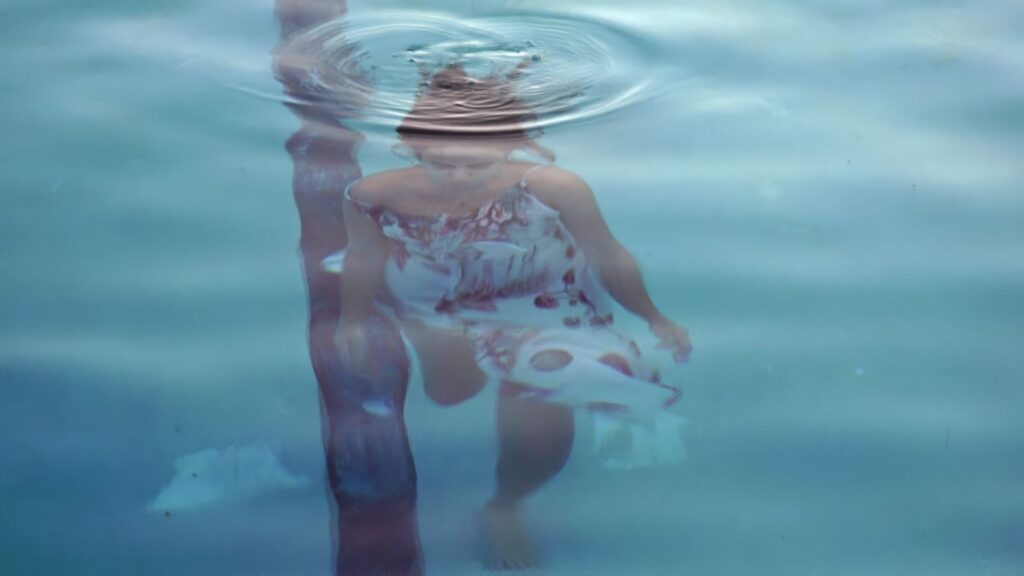
Queried about water, Mettler is quick to respond. “It’s an awareness of this element that permeates everything, including our bodies, that keeps us alive. I remember telling somebody, and then they quoted it back to me like years later: when in doubt, follow water. And it’s true. It just opens up worlds. Whether it’s the humidity of your breath going into the clouds or the glacier melting, I want it to be present.
“We were surrounded by a lot of snow and it’s all going downhill where I live in the Rhine Valley. Following those, going back up to the source, was my initial strategy. Along the way, you make all these discoveries, whether it’s bunkers that are hiding in the mountains or the full circle that I was taken on, which took me back to the clinic in Part Seven, where I had been in part One looking at a trickle of water that I was following.”
Mettler’s work is a record of journeys, filmed lyrically in diverse settings ranging from New Mexico’s mountains through Manitoba’s rivers to Cuba’s caves and Switzerland’s gorgeous falls. Whether it’s travelling America’s iconic highways or the glorious splendours of the Swiss Rhine Valley, Mettler’s diary shows us the beauties of nature while propelling us forward on a seemingly endless quest to discover something new—only to discover that life is in cycles that constantly reinforce themselves.
“Cycles is a good word to describe it,” comments Mettler. “And, of course, mortality, how mortality fits into those cycles. I think that’s the thing that was the unexpected narrative of both my parents disappearing and my own mortality coming into play. I’ve always loved transitions.”
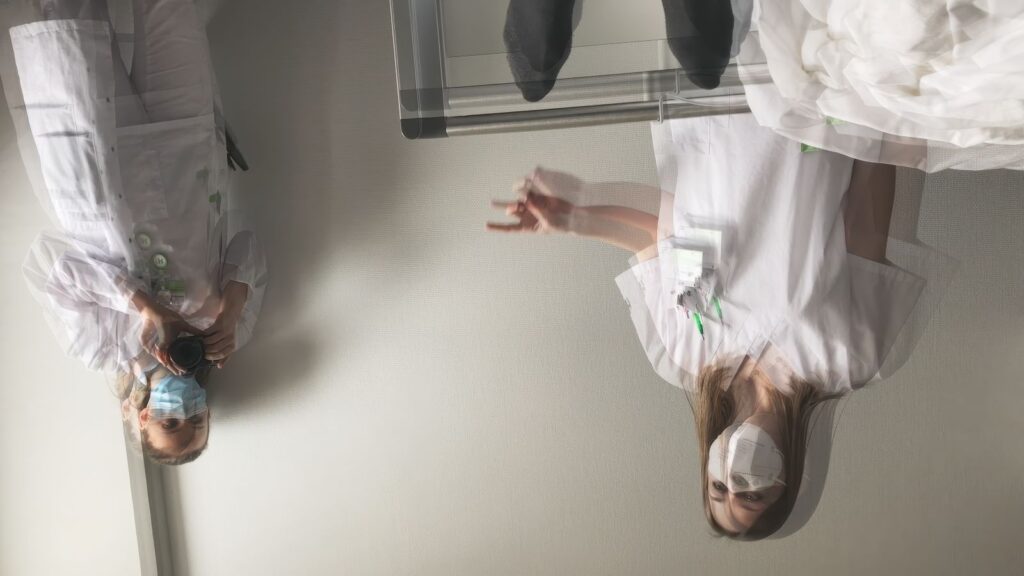
Possibly because it’s a diary, While the Green Grass Grows is splendid while depicting our strange life during COVID. Mettler places us slowly and surely in Toronto’s ravines, where he has intimate conversations with friends, and online, talking with comrades on Zoom—missing them, but still communicating. Says Mettler, “During COVID, I think it happened to everybody, or many people: the awareness of the simple cycles of nature. We had more time to be alone in nature and things slowed down somewhat. I think people perceived the springtime quite differently in that first year than normal because the pace had been changed.”
While the shooting of the film was quite spontaneous in parts, the editing of While the Green Grass Grows took years of work alongside a remarkable assistant, Jordan Kawai. Speaking to the editing process, Mettler states, “It was not a premeditated structuring. There were some themes that are just innate in me.

“The first level of structure that I didn’t want to depart from is chronology. I think when you follow chronology, it’s interesting to see all the coincidences that emerge. And some of those coincidences are tuned exactly by the fact that something has happened before and you’re recognizing it or anticipating it coming up again.
“Where a lot of time was spent with Jordan and myself was sculpting out the details inside that—enhancing relationships, enhancing coincidences—and bringing in my experience. It’s a more personal film than anything I’ve done before in terms of actually sharing myself, sharing my image, sharing my parents, sharing my feelings. That was, you can say, structural too, because of the diary.
“I’ve thought a lot about the coincidences that emerge in my life and in the film. I see them as ways of organizing the chaos of organizing my intentions, my identity. But I’m not religious about it.”
Asked about his intent with the film, Mettler replies, “What was driving me was the process of exploration, of not being driven by a script, not even being driven entirely by a theme, but engaging with the world and seeing what becomes of it. I find that’s very exciting and informative and there’s secrets in there: to understand things about how we see the world, how we interact, how we use media as part of our reality.”
While the Green Grass Grows is Peter Mettler’s magnum opus, a personal account of experiencing life with depth, humanity—and no grand statement. It takes us on a long and enjoyable journey and expects nothing more from us than to be there to enjoy the ride.
While the Green Grass Grows premiered at TIFF 2025.
It screens as part of TIFF‘s Mettler retrospective on October 12.
The post A Travelling Spirit: The Journeys Within While the Green Grass Grows appeared first on POV Magazine.
Related Articles
Visions of the Croisette: The Ultimate Prediction for the 2026 Cannes Film Festival Main Competition
Caught between streaming algorithms and geopolitical upheaval, does cinema’s “sacredness” still matter? A Los Angeles–based team predicts the 22 Palme d’Or contenders for Cannes 2026—from PTA and Östlund to Panahi, Rohrwacher, and beyond.
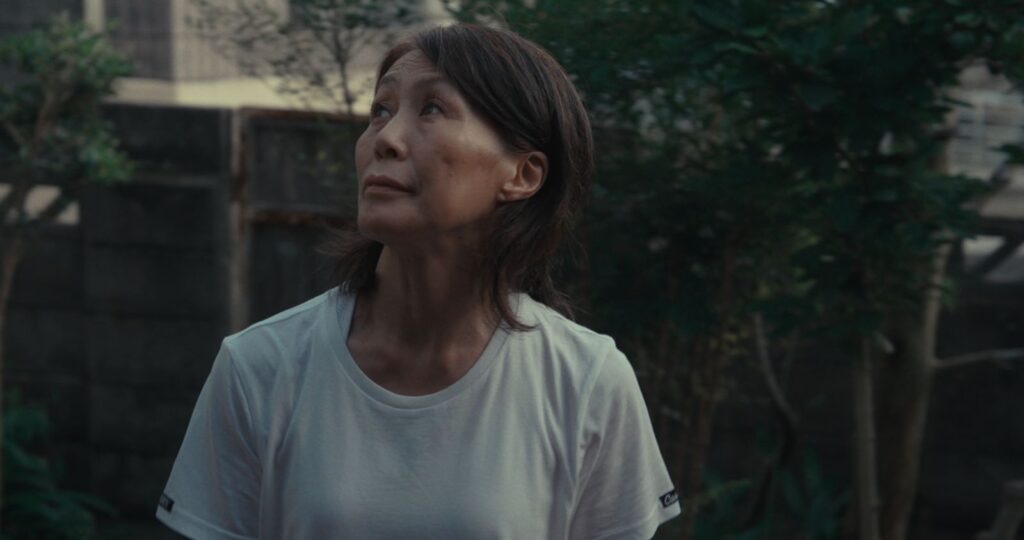
The Memory Palace: Or, If These Walls Could Talk
How films like Okuirmono, The Nest, and This House explore the histories embedded within the walls of our family homes. .
How Twisted Yoga Centres Care Amid a Web of Lies
An interview with Twisted Yoga director Rowan Deacon and executive producer Suzanne Lavery on their true crime doc now streaming on Apple. .