How The Tale of Silyan Magically Blends Myth and Reality
An interview with The Tale of Silyan director Tamara Kotevska and cinematographer Jean Dakar about capturing the relationship between a farmer and a white stork that proves his kindred spirit. The post How The Tale of Silyan Magically Blends Myth and Reality appeared first on POV Magazine.
A Macedonian fable tells the tale of Silyan, a young man who gets transformed into a stork when he angers his father by sharing his desire to leave the family farm. As stork Silyan gets used to his new wings, he realises they don’t afford much freedom and he desires to return to human form. However, the bitter resentment that his father holds prevents the curse from reversing. Silyan forever wanders, unable to ever go home again.
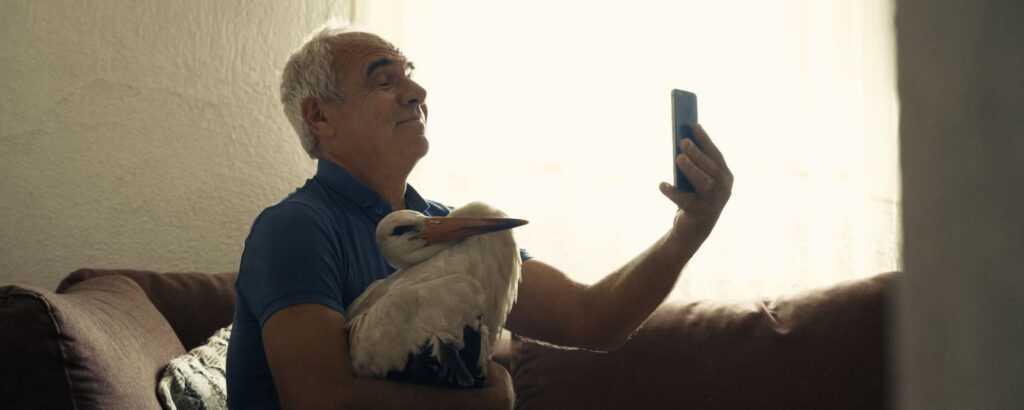
In The Tale of Silyan, the exquisite documentary from director Tamara Kotevska (Honeyland), a fallen stork named Silyan appropriately serves as the link between worlds both human and animal. The film follows a farmer named Nikola, whose operations fall on hard times amid new government policies that make farming unsustainable. As Nikola’s wife, Jana, moves abroad to care for her granddaughter so that their daughter, Ana, can earn a living, Nikola gets a job at the local landfill. On the job, he befriends a wounded stork that munches on trash in the absence of rotten tomatoes left by farmers’ waste. Nikola takes the stork into his home and mends his broken wing. In turn, the bird lifts his spirits as the farmer rouses from a slump inspired by his family’s departure. Their touching relationship envelops an urgent reality with an element of myth as the folktale evokes the larger human migration affected by economic hardships.
And while Nikola’s encounter with Silyan might seem fortuitous, it’s actually the bird’s encounter with the human that lends the doc its stroke of genius. “This story started by following the storks,” explains Kotevska, speaking with POV via Zoom. “We started following the storks, eating from landfills and changing their migrational paths. This is something that captured my attention as an environmentalist. I wanted to make a comparison with how they usually eat, which is on human agricultural lands. By following the storks eating from farmers’ lands, we met about 10 families of farmers.”
The director says that Nikola and Jana’s family become the focus of the human side of the story “because they had a beautiful appearance for the camera.” The observational approach intimately captures the family in their domestic setting as they harvest the land, but struggle to sell their bountiful crops at a fair price, which complicates the family dynamic as the confront their new reality. “They were very free,” says Kotevska. “They had a beautiful chemistry between one another. We also knew that the daughter [Ana] was migrating, which I found to be a crucial element.”

It’s easy to see why the storks might initially pique ones interest. The Tale of Silyan observes the many beautiful birds that occupy Nikola’s neighbourhood, as Macedonia is home to the largest white stork population in the world. Cinematographer Jean Dakar, who previously collaborated with Kotevska on their documentary The Walk, captures the birds flying through the air, nesting atop telephone poles, hunting frogs, and foraging in the farmers’ field. The documentary gradually and deftly connects the lives of the birds with those of their human compatriots. The birds are protagonists and symbols with equal measure.
“Storks are extremely intelligent animals and they definitely recognize individual people. They also have their own characters, really,” says Dakar when asked how one casts birds compared to humans. “While it’s difficult to recognize storks physically, you see different personalities and you recognize the storks that way.” But the cinematographer observes that filming the storks just arises through a mix of time and patience.
“Throughout the entire three years of filming this project, we never stopped learning,” Dakar continues. “With every nest that we spent time with and focused on, we sat and observed, wrote notes, and studied the animals for a very long time to understand what makes each stork family different—what times they’re heading out to feed and when they’re coming back with to feed to their youngsters. Gathering all of this information made us ready to know when to take out the camera or when to fly the drone and capture the right moment.”
The research pays off as the birds’ own comfort with the filmmakers allows Dakar to compose images of true visual poetry with shots inspired by Terrence Malick’s A Hidden Life harnessing the warmth of the sun. But besides the sense of wonder inspired by the images of storks flapping through the sky during magic hour, the observational approach truly elevates the nature documentary genre by capturing animals up close in action.
“They got accustom to us and our equipment. We thought maybe they’re going to allow us to fly with them, which they ended up doing, especially the generation that grew up, the ones that hatched their eggs when we were present,” says Dakar. “They were completely accustomed to the drone. It was just another thing, part of their life. Those were specifically the storks that let us fly really close next to the midair, hundreds of meters up in the sky.”
While The Tale of Silyan captures majestic moments with the storks, and deftly parallels their plight with those of their human counterparts, Dakar says it simply isn’t possible to “direct” or guide a stork into action. Instead, the film’s fluid cinematography speaks to the relationship built with the birds over time.

“You have to know as much as possible about the animal so that you can anticipate what he’s about to do,” explains Dakar. “Let’s say, for example, the moments when they’re clacking.” The documentary features striking shots where the birds arch their long necks and flip their beaks backwards, clacking in a disquieting chorus that builds the film’s rhythm while stressing the power dynamics at play within the human story.
“That was something that happened a lot during April, which is when the storks are returning and are starting to nest,” says Dakar. “There’s a lot of competition between the storks and who gets to conquer which nest. During that time, there’s a lot of this clacking and being territorial and offensive, so we have to know about the animal: when he does it and what he does, and then work around that.”

Kotevska agrees that there’s no directing a bird, and says that the disciplined observation affords the documentary its quietly effective narrative flow. “We were curious about what’s going to happen with this relationship [between Silyan and Nikola], so we were just witnessing this every day with our camera,” she says. “And then in editing, I discovered this beautiful arc that started to build, which I didn’t even notice when shooting because we spent hours and hours just observing. Later, we discovered these precious little moments that show the personality of the stork and the building of his character and relationship with Nikola.”
The relationship between the farmer and his feathered friend obviously offers a stroke of documentary gold. Nikola considers the distance between his own family, the stork’s symbolic presence as an adopted “son,” and the idea of return. He hopes for Jana and Ana to come back to the farm, whereas the Silyan of the fable never could. Kotevska says that had Nikola not stumbled upon the injured bird in the landfill, their shoot would have gone a very different route.
“It was going to be much more about the migration of the species. At one point, we were planning to follow the storks all the way to Africa and the family migrating to another land,” she notes. “So when we captured this situation, it naturally excluded other ideas because the material was quite powerful. It became the third act of the film, actually.”
Moreover, witnessing this relationship between Nikola and Silyan, Kotevska admits there are relatively few differences when it comes to shooting the stores of people and their animal friends. “When you shoot documentaries, you realize that humans are actually just another type of animals with their own routines and habits and behaviors,” she says. “You just approach them understanding the subject. The more about the subject you learn, the more you’re capable of capturing on camera.”

It’s here that the intimate scope lets The Tale of Silyan explore interconnected themes, stakes, and geopolitical concerns at levels both micro and macro. By observing one family of farmers and connecting them with a myth passed down between generations, the film’s tight focus captures a bigger picture
“What happens is that you watch it from a more emotional standpoint rather than from an educational one,” says Dakar. “We think that this is a very powerful tool to engage somebody and to let them be aware of where this issue is.”
When the film expands the scope beyond the family, it finds events that are immediately compelling. After farmers leave markets defeated, transporting full wagons of healthy crops that will spoil unsold, they unite in protest. The farmers stage a demonstration where they smash their produce in the street, offering proof of the hardship they face and the waste produced by strict government policies. But a bad day for the farmers proves Christmas for the storks. They follow the carnage and clack along while scooping up tomatoes, cabbages, and potatoes, among other goodies.
The filmmakers admit that the situation for farmers in Macedonia hasn’t improved much, but they’re hoping to change that with the film. Moreover, audiences wondering about possible connections between Nikola’s plight and that of Hatidze, the honey farmer from Honeyland, should know that the government policies affect her as well, although not quite as severely because she deals in honey. “There’s always a very high demand for honey,” explains Kotevska. “It’s different with other products that are more for everyday use or they’re produced in tons where honeys produces smaller quantities and the price is higher.”
Whether honey or produce consumed by humans and storks alike, Kotevska hopes that the tale of Silyan and Nikola inspires awareness about sustainability and the economic currents fuelling human migration. “I hope that people will become more observant of the other communities that live in their country, because I think modern societies are really segregating,” she says. “We are living in our own bubbles and we are not aware how we are getting our products. We are becoming attracted by consumerism without being aware of it, and we don’t pay attention to what’s happening in the larger scale of our societies.”
“It’s an important reminder that wealth is not just measured in one’s financial resources, but also in compassion in our families and in connection to nature,” adds Dakar. “Life is getting tougher. It’s important to remember these values and we hope that this film is going to serve as a reminder to all of us.”
Somewhere, a bird cranes its neck back and unleashes a hearty clack in agreement.
The Tale of Silyan opens in select theatres Dec. 5 and expands throughout the month.
It is coming soon to Disney+.
The post How The Tale of Silyan Magically Blends Myth and Reality appeared first on POV Magazine.
Related Articles
Visions of the Croisette: The Ultimate Prediction for the 2026 Cannes Film Festival Main Competition
Caught between streaming algorithms and geopolitical upheaval, does cinema’s “sacredness” still matter? A Los Angeles–based team predicts the 22 Palme d’Or contenders for Cannes 2026—from PTA and Östlund to Panahi, Rohrwacher, and beyond.
The Memory Palace: Or, If These Walls Could Talk
How films like Okuirmono, The Nest, and This House explore the histories embedded within the walls of our family homes. .

Exposing the Dark Truth of Digital Totalitarianism: Documentary 'Eyes of the Machine' Arrives in Prague as One World Film Festival Opens
Following its acclaimed premiere at IDFA Amsterdam, investigative documentary Eyes of the Machine screens at One World International Human Rights Documentary Film Festival in Prague, with Uyghur witness Kalbinur Sidik attending in person.