The Longer You Bleed Shares the Pros and Cons of Doomscrolling

An interview with The Longer You Bleed director Ewan Waddell about chronicling the invasion of Ukraine via doomscrolling and viral videos. The post The Longer You Bleed Shares the Pros and Cons of Doomscrolling appeared first on POV Magazine.
In 2017, British filmmaker and artist Ewan Waddell created a clothing collection while living in Australia called, “Social Media Is Ruining Our Lives.” A short film would follow soon after bearing the same title.
Meant to be a light-hearted, tongue-in-cheek observation about the effects of technology on society, the phrase gains greater meaning nearly 10 years later.
“It was just a joke,” Waddell tells POV over Zoom. “You’d look around on the train, and everyone’s on their phones, which isn’t that crazy — look at pictures on the subway in the early 1900s, people are just reading newspapers. People are absorbed by media in whatever form.”
He adds, “But I guess it’s just the intensity of this sinister addictive design which has come around now which changes things.”
Apathy as a by-product of this change sits at the heart of Waddell’s feature-length directorial debut, The Longer You Bleed.
In the film, Waddell speaks with young Ukrainians experiencing the ongoing Ukraine-Russia War in real-time and through their phones. While watching them scroll across Instagram feeds laden with horrific images of violence and displacement, we hear their matter-of-fact commentary over top: “I’m just scrolling and that’s all. It’s like oh, ‘next, next.’ I’m feeling that I’m a bit dead inside,” they say.
Throughout recent history, photojournalists have played an important role during wartime by documenting wartime atrocities. The images they capture not only play witness to acts of war, but they give people back home a window into the realities of war. These pictures are meant to shock the general public, instead resolving us to plead with our governments to enact peace not war.
The Ukraine-Russia War will take its place in history for a number of reasons, least of all that it’s one of the first full-scale invasions on a sovereign nation whereby the vast majority of civilians could take their own videos and photographs and send them around the world in seconds. The speed by which these images could be disseminated provided fellow Ukrainians with up-to-date information and alert them of incoming danger, but the frequency by which the attacks came — and, in turn, the visuals online — thickened the skin of those scrolling to the point of numbed indifference as shown in The Longer You Bleed.
Waddell and his Ukrainian partner Liuba Dyvak (who also appears in the film and serves as producer) went to Bucha and Irpin a year after the attack on Ukraine by Russia in 2022 that would escalate the war in earnest, which included the Bucha massacre as it is now known.
But when Waddell surveyed the area, he found himself having to reconcile a lack of emotions, rather than the “gut reaction — something which gives you a strange feeling on your skin” he anticipated.

“It didn’t punch me or shake me as much as I thought,” Waddell recalls. “I was expecting I would go to those places, and there would be these rushes of thoughts and emotions, just this chaotic storm in my head, and I would be able to feel a visceral shift in my perspective. But I didn’t.”
Instead, Waddell felt himself considering the sights he saw “in an inhuman way, a bit more logical or intellectual,” he says. “I was just thinking about and analyzing the things that happened, as opposed to feeling the weight of them.”
In retrospect, and after exploring this sensation (or lack thereof) in The Longer You Bleed, Waddell considers the disconnect between the war images we constantly see in media, particularly fictionalized representations, and seeing them first-hand.
“[Studios and filmmakers] have to make them kind of simplified and one dimensional. But the reality of experiencing things is that you don’t just feel one emotion at a time, you feel a million emotions all the time, and the way they interact with each other,” says Waddell. “It’s really confusing and bizarre. There’s not necessarily one [emotion] that’s dominant above all the other emotions. They just mess together and it fucks with you. Fucks with your mind.”
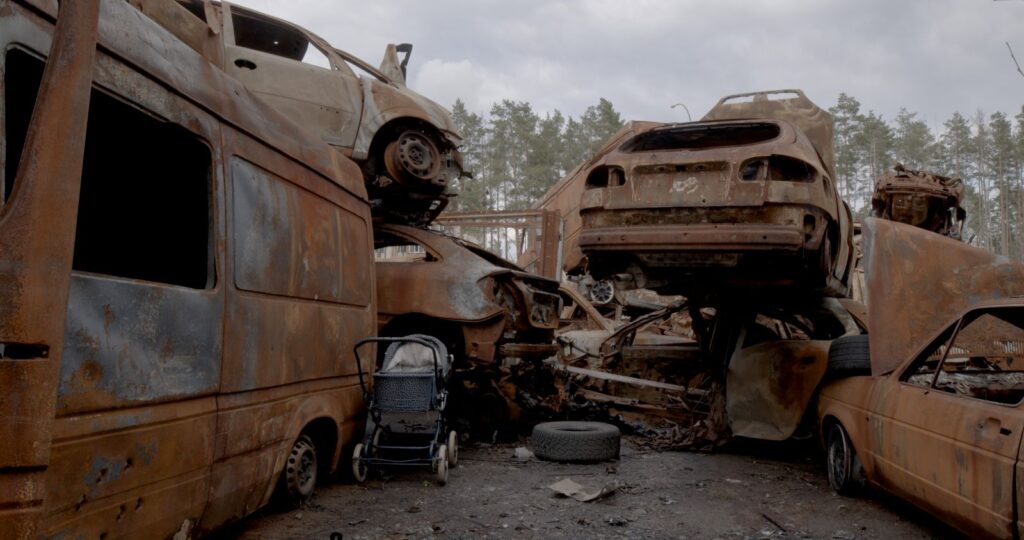
Perhaps then, it’s a survival instinct. Our brains power down to an anaesthetized setting, rather than deal with the onslaught of fear, anger, frustration, helpless, and whatever else ferociously pinging around with no place to settle.
Throughout The Longer You Bleed, Waddell, Luiba and their friends discuss extensively how their emotional response to the war has atrophied over time, pointing specifically to the prevalence of seeing the war play out like an internet meme. However, in spite of the position his film takes, Waddell never intended for The Longer We Bleed to be a takedown of social media, or to lay out reasons why it shouldn’t exist — quite the contrary in fact: he strongly asserts that social media has been a net positive to society. For instance, the film shows how many Ukrainians, Luiba included, harness the power of social media to correct the narrative about Russian’s invasion.
“Of course, there’s a lot of negatives, which [are] important to identify, but I think there’s so many positive things in terms of the power of the individual voice, holding powerful people, institutions or governments accountable, the nature of fast connectivity which isn’t mediated by companies or governments,” he explains.
When POV spoke with Waddell, it was ahead of the world premiere of his film at Hot Docs in Toronto last year, and in the nine months since our conversation, his words have only proven even more relevant as ICE raids grow increasingly rampant across the United States. The truth behind many government narratives and news stories have been revealed through the videos captured by onlookers and bystanders, which they promptly posted to Instagram and TikTok for the world to see.
Waddell’s film considers the aftermath — what happens when we’ve seen one too many images — and in highlighting the issues surrounding those concerns, he consequently brings to light the potential of social media, when approached thoughtfully.
“It’s really important to discuss [the negative issues with social media] and figure out how to navigate them, both in terms of the design of the platforms and also how we are mindful about using them,” says Waddell. “But I think, optimistically, we can find solutions [and] solve these issues.”
It’s a message of optimism that the world sorely needs at the moment.
The Longer You Bleed screens at ReFrame Film Festival on Feb. 1 and in the online fest Feb. 3.
The post The Longer You Bleed Shares the Pros and Cons of Doomscrolling appeared first on POV Magazine.
Related Articles
Visions of the Croisette: The Ultimate Prediction for the 2026 Cannes Film Festival Main Competition
Caught between streaming algorithms and geopolitical upheaval, does cinema’s “sacredness” still matter? A Los Angeles–based team predicts the 22 Palme d’Or contenders for Cannes 2026—from PTA and Östlund to Panahi, Rohrwacher, and beyond.
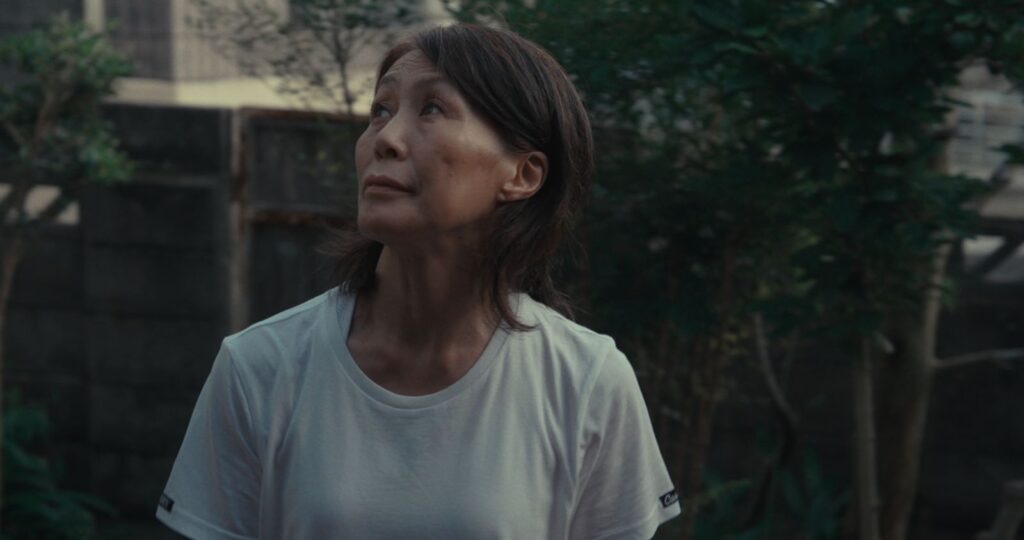
The Memory Palace: Or, If These Walls Could Talk
How films like Okuirmono, The Nest, and This House explore the histories embedded within the walls of our family homes. .
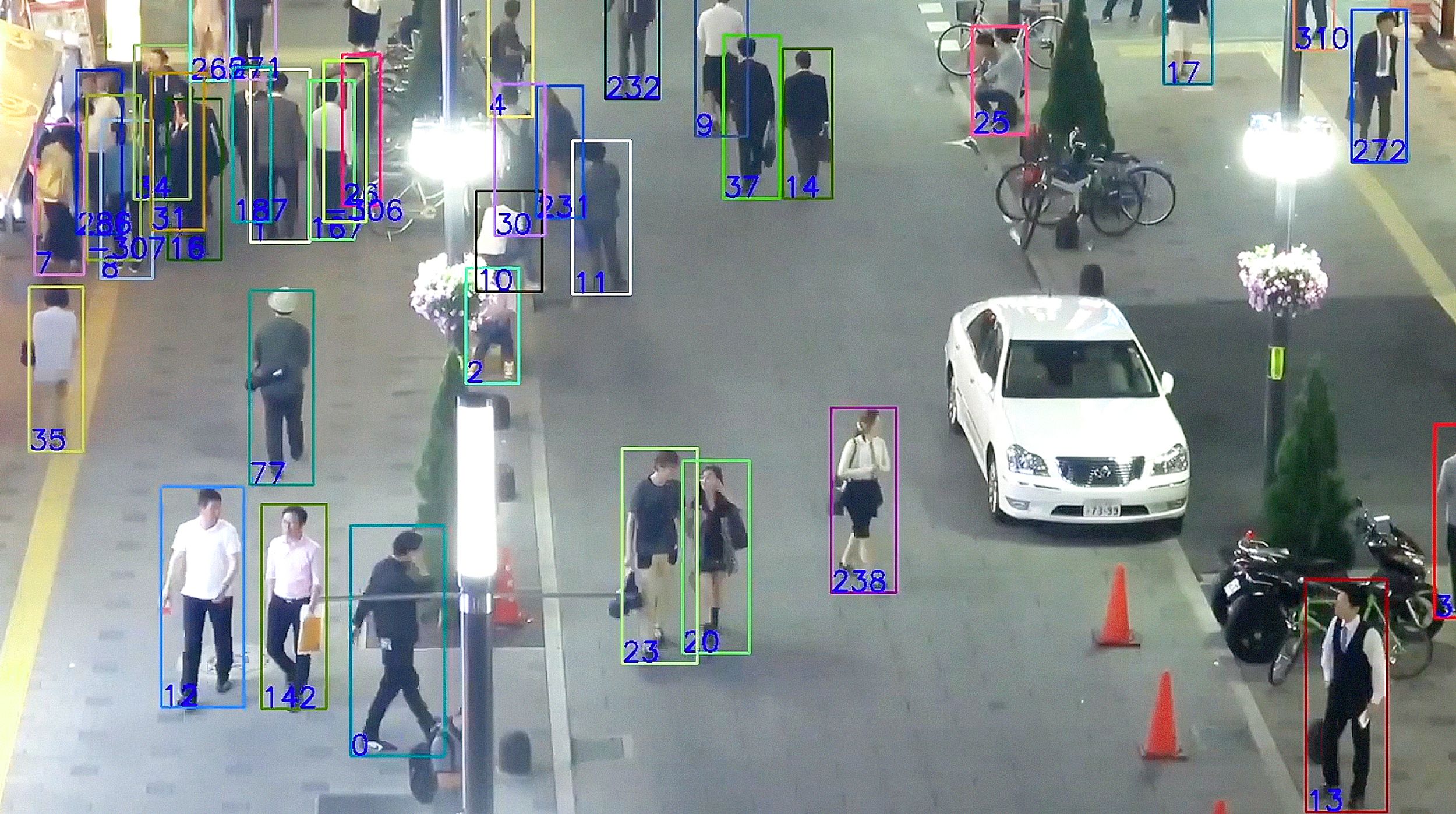
Exposing the Dark Truth of Digital Totalitarianism: Documentary 'Eyes of the Machine' Arrives in Prague as One World Film Festival Opens
Following its acclaimed premiere at IDFA Amsterdam, investigative documentary Eyes of the Machine screens at One World International Human Rights Documentary Film Festival in Prague, with Uyghur witness Kalbinur Sidik attending in person.