The Truth, Ruth

On the documentaries of Spike Lee and an artist who never shies away from the truth, whatever form the story takes. .
In Spike Lee’s eleventh feature Get on the Bus (1996), which follows a collective of Black men from various backgrounds and age groups on their tumultuous road trip to the Million Man March in Washington, D.C., a character named Xavier mills about the periphery, camera in hand. The young man is a film student, trying to shoot a documentary on what he knows will be a historic event. Another character later refers to him, mockingly, as “Spike Lee Jr.”
It’s a sneaky, self-deprecating joke, complementing the subject matter of the film in question, and also arriving at a fitting point in Lee’s career. Ten years, and as many movies, after his breakout She’s Gotta Have It (1986) put him on the industry’s radar, he’d proven himself as one of the most vital voices in American filmmaking all before his fortieth birthday. But there’s an escalating pressure that comes with continually raising the bar. In hindsight, this throwaway line prophesied the director’s first pivot to nonfiction, 4 Little Girls (1997), one year later. Documentaries would become a fruitful outlet of expression for Lee in the decades that followed.
On the one hand, a mode of storytelling that encourages direct appeals to its audience seems tailor-made to a filmmaker so frequently accused of didacticism. On the other hand, his penchant for melodrama presents potential friction with a practice that strives to represent reality. There are, however, many tendencies in Lee’s best-known films—characters addressing the camera, juxtapositions between archive and artifice, a variously permeable fourth wall—that chart a direct course from fiction to nonfiction, and his documentaries chase these aesthetic impulses to their logical endpoint.
4 Little Girls unravels the historical, political, and personal conflicts that periodically shook and shaped Birmingham, Alabama, once described by Martin Luther King Jr. as the “most thoroughly segregated city in America.” It explores the tumultuous years surrounding the bombing of the 16th Street Baptist Church in 1963, which claimed the lives of four Sunday school students. The film’s opening sequence, serenaded by Joan Baez’s gutting dirge “Birmingham Sunday,” surveys the young girls’ gravesites and other monuments to their memory, intercut with archival footage of protests and photographs from their publicised funerals. The murders were critical to the mobilization efforts that led to the passing of the Civil Rights Act in 1964.
Rather than merely situating these martyrs in the context of history’s pitiless, implacable sweep, Lee structures the film around their positions within the community. Parents, neighbours, relatives, and schoolmates recall the girls’ generous and lively spirits thirty years removed from the pain of their loss. The camera watches, in sometimes excruciating yet unwaveringly empathetic detail, as long-buried memories and emotions brim to the surface, rippling across interviewees’ faces. Explorations of familial and municipal history are bridged by first-hand testimonies to the everyday anguish of segregation. In an especially shattering scene, Christopher McNair recounts a painful explanation of this evil concept to his daughter, and “the whole world of betrayal” that fell upon her in that moment of understanding.
4 Little Girls is uncharacteristically reserved for Lee, who seems willfully and studiously constrained by the formal precepts of this new mode of storytelling. Leaning heavily on talking heads and archival footage, the film’s technique at first seems to squarely conform to the house style of HBO documentaries. Still, there are subtle flashes of experimentation to be found—roving, strikingly fragmented close-ups on objects, hands, and faces; harsh lighting that comes across as both strangely intimate and knowingly stagey; provocative backdrops that clash with and complement the words of a speaker in the foreground—which indicate that Lee is adhering to the general contours of standard practice while still colouring outside the lines. Though this director could never be called timid, there’s an evident restraint on display, an implicit understanding of the pressures and responsibilities that come with telling stories of real people about their own struggles, emotions, and lives.
After the success of 4 Little Girls, Lee turned his camera toward a wide range of artists, athletes, celebrities, and comedians in the decades that followed. Though he directed biographical projects chronicling the lives of Jim Brown (All- American, 2002) and Michael Jackson (Bad 25, 2012 and Michael Jackson’s Journey from Motown to Off the Wall, 2016), he mainly explored entertainers in their element: one-man shows and stand-up routines by John Leguizamo (Freak, 1998), Steve Harvey, D.L. Hughley, Cedric the Entertainer and Bernie Mac (The Original Kings of Comedy, 2000), Mike Tyson (Undisputed Truth, 2013), Katt Williams (Priceless: Afterlife, 2014) and Jerrod Carmichael (Love at the Store, 2014); the Broadway ensemble hit David Byrne’s American Utopia (2020); and a day-in-the-life shadowing of Kobe Bryant (Kobe Doin’ Work, 2009). These films are enthusiastically attuned to the exertions and exaltations of physical performance, formally unified by their director’s attention to the gestures of his chosen subjects. By honing in on body language, physical presence, and how they relate to a given space, Lee captures subtextual facets of their artistry that a live audience might miss.

Spatial and gestural grace notes abound in A Huey P. Newton Story (2001), the strangest and least classifiable of Lee’s performance docs. The film is a televised version of a one-man show masterminded by multimedia artist and regular Lee collaborator Roger Guenveur Smith, who recites, rambles and riffs his way through a full-throated impression of the man who co-founded the Black Panther Party. The credits play overtop a collage of archival materials from the “Free Huey” era. Afterwards, a match is struck and brought to the tip of a cigarette, flashbulbs blazing as we cut between Smith’s profile and stock footage of photographers aiming their lenses. “Testing, testing,” drawls Smith-as-Newton, who’s seated with a mic on an elevated platform surrounded on all sides by two floors of silhouetted onlookers. The production design, dotted with fluorescent lights and chain-link fences, evokes a cellblock, but the staging symbolically places Newton on the witness stand.
From there, he launches into a 70-minute monologue, which nimbly and dizzyingly blends biographical detail, rhetorical flourish, gallows humour and poetic license. Lee shoots Smith with a shivering, frenetic style, his finger kept firmly on the staccato pulse of this actor’s impersonation—so much so that the project becomes two films, one about Huey P., the other about Roger G. Rear projections of archival clippings flash behind him as he talks, staging clashes between artifacts of history and artistic interpretations of it. Though the film, one of Lee’s most rich and underseen, refuses to comfortably fit the documentary mold, he deploys the format’s techniques for the purposes of vividly embodied fiction, mining ecstatic truths about performance, celebrity and legacy in the process.
Spike Lee’s most ambitious pieces of nonfiction would begin half a decade later. When the Levees Broke: A Requiem in Four Acts (2006) is the filmmaker’s staggering attempt to document the incalculable effects of Hurricane Katrina on the overwhelmingly Black and poor residents of New Orleans, Louisiana, who were abandoned and displaced en masse by George W. Bush’s criminally callous administration. Five years removed from the disaster, he returned with If God Is Willing and da Creek Don’t Rise (2010), which investigates the storm’s lasting impact on New Orleans and the persistence of man-made crises in one of the most neglected states’ most neglected cities: public housing projects left vacant by evacuations and opportunistically torn down by city officials, school systems commandeered by well-meaning yet oblivious outsiders, and the Deep Water Horizon oil spill, which did irreversible damage to Louisiana on every economic and environmental level imaginable. Lee’s fearless looks at New Orleans form a bleak yet defiant tribute to the bottomless resilience of a community constantly relegated to the short end of the stick.
When the Levees Broke begins, like many of Lee’s films, with a montage. This three-and-a-half-minute sequence, set to Louis Armstrong’s peerless “Do You Know What It Means to Miss New Orleans,” weaves together snapshots of the city’s history with footage from the immediate aftermath of the most devastating natural disaster in American history. Corralled together by Sam Pollard, who also edited 4 Little Girls and five of Lee’s fiction films, this miniature masterpiece is one of the most haunting things in the director’s entire filmography and completely changes the meaning of Armstrong’s song.
This harrowing doc covers seemingly every angle available across its four hour runtime, guiding the viewer through the disaster as it developed, climaxed, and subsided from the shifting perspectives of civilians, politicians, reporters, police chiefs, army colonels and even celebrities who tried to lend a hand. It features 130 interviews, cites hours of news coverage, and compiles countless photographs taken by journalists on the ground. It’s the apex of Lee’s investigative capabilities and also of his classical impulses. Here, he oversees the delivery of information with a dutiful sense of passion and curiosity, keenly aware of this story’s magnitude and his position as the conveyor, not the teller. Nowhere is this more evident than in his interviews; we hear the director’s voice sparingly, but his empathetic prompts are an implied reverse shot to the emotional excavations that his subjects offer to the camera.
The scope is so massive, a viewer could easily get lost in the endless barrage of facts, faces, testimonies and injustices. There’s devastating footage from helicopters as survivors wave signs and flags, pleading for rescues that may or may not come; we see bloated bodies left to rot by a municipal government more concerned with arresting looters; and audiences stare as elderly, starving and disabled survivors are shown, forced to live in the city’s overcrowded Superdome for nearly a week with no plumbing or resources.
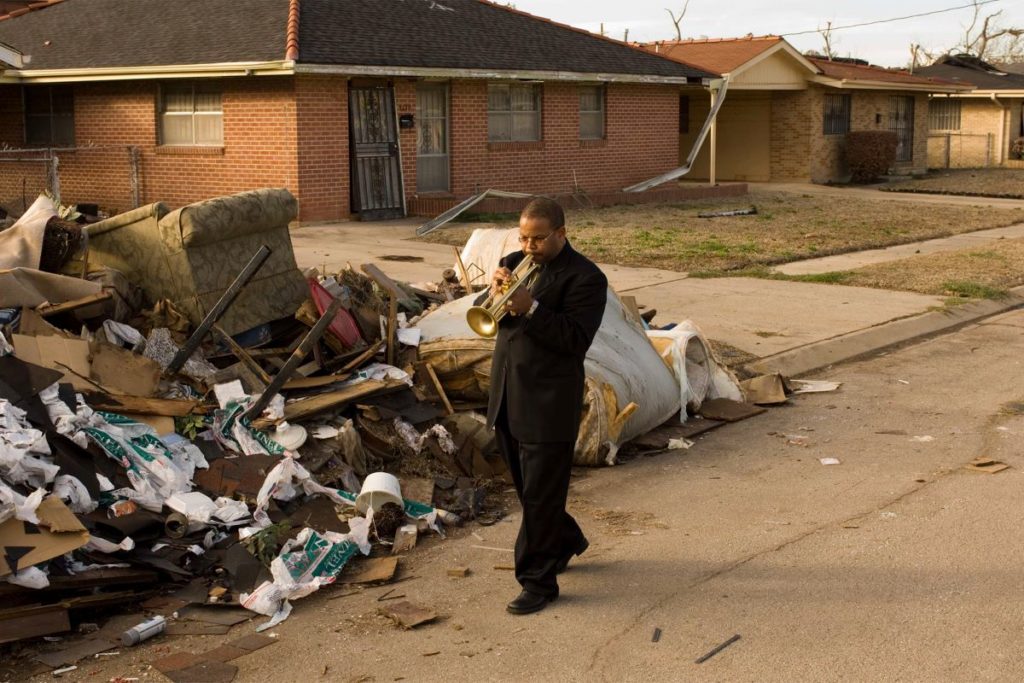
These images are soundtracked by the testimonies of New Orleans’ outraged, traumatized residents and, crucially, by the haunting brass compositions of Lee’s regular collaborator Terence Blanchard. A New Orleans native himself, the musician’s family home was one of thousands destroyed in the floods when the shoddily built levee system catastrophically malfunctioned and submerged 80% of the city. In an unforgettable shot, Blanchard strolls through the wreckage of his neighbourhood, a mournful tune emitting from his trumpet.
It’s fitting that the hands of Lee’s collaborators are felt so profoundly in these documentaries. Lee is a filmmaker with an unmistakable personal stamp, whose work reliably and ineluctably expresses his individual interests and sensibilities as an artist. But those interests have always been aligned with notions of the collective. The Katrina/ New Orleans films are the largest canvas he’s ever been given as a filmmaker, and he fills it almost entirely through the experiences of others. It’s a titanic tapestry, his ultimate gesture of generosity to a local culture so repeatedly deprived of it. This mission is pushed to its conceptual endpoint during If God is Willing, when Lee dedicates the final twelve minutes to individual portraits of every interview subject, each one encompassed by a decorated picture frame, reciting personal facts of their choosing.
With recent projects including the dramas BlacKkKlansman (2018) and Highest 2 Lowest (2025) and the documentaries American Utopia, NYC Epicentres 9/11–2021 (2021) and a series on football player Colin Kaepernick (still in the development stages), it’s clear that the push and pull between fact and fiction, and individual artistry and collective portraiture are mainstays in Lee’s prolific, shape-shifting filmography.
The post The Truth, Ruth appeared first on POV Magazine.
Related Articles
Visions of the Croisette: The Ultimate Prediction for the 2026 Cannes Film Festival Main Competition
Caught between streaming algorithms and geopolitical upheaval, does cinema’s “sacredness” still matter? A Los Angeles–based team predicts the 22 Palme d’Or contenders for Cannes 2026—from PTA and Östlund to Panahi, Rohrwacher, and beyond.
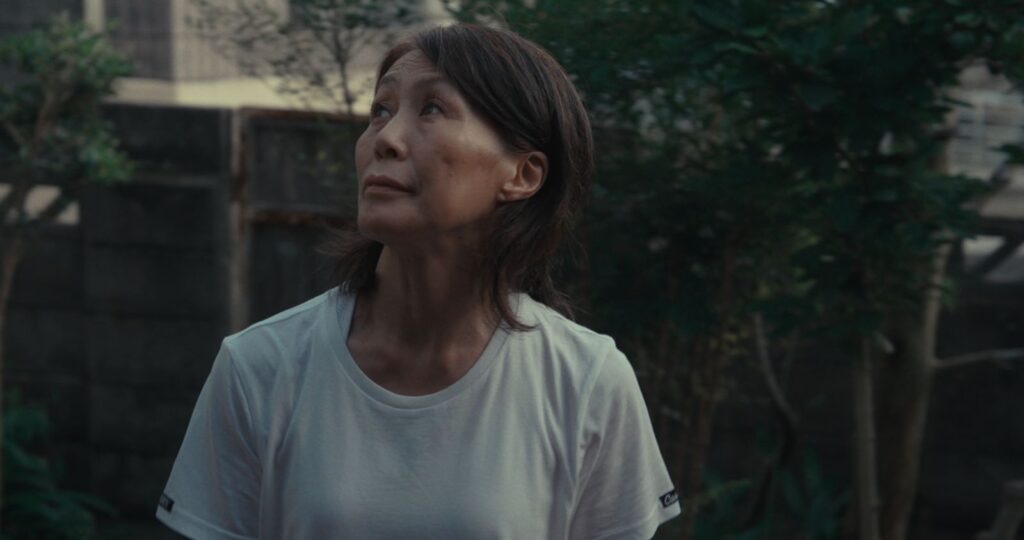
The Memory Palace: Or, If These Walls Could Talk
How films like Okuirmono, The Nest, and This House explore the histories embedded within the walls of our family homes. .

Exposing the Dark Truth of Digital Totalitarianism: Documentary 'Eyes of the Machine' Arrives in Prague as One World Film Festival Opens
Following its acclaimed premiere at IDFA Amsterdam, investigative documentary Eyes of the Machine screens at One World International Human Rights Documentary Film Festival in Prague, with Uyghur witness Kalbinur Sidik attending in person.