With Oscar Voting Closed, the Documentary Race Seems too Close to Call

Surveying the candidates in the Academy's most unpredictable branch as the Oscar race for Best Documentary Feature is wide open ahead of this week's nominations. The post With Oscar Voting Closed, the Documentary Race Seems too Close to Call appeared first on POV Magazine.
Oscar voting is officially closed and there is only one safe bet on the documentary front: anything could happen. The race for Best Documentary Feature is wide open. The fifteen films on the shortlist all have a respectable chance with voters in the Academy’s most unpredictable branch.
The shortlist has a mix of frontrunners and hidden gems, plus titles with huge backing from the streamers. However, many films on the list are still seeking distribution. Those factors are in play with the increasingly international and politically engaged branch.
As of publication, awards predictions site Gold Derby has the top five odds-on favourites, in order, as 2000 Meters to Andriivka, The Perfect Neighbor, The Alabama Solution, Cover-up, and Apocalypse in the Tropics, while Variety calls the top three of those contenders “vulnerable” in a branch “with voters acknowledging a pattern of snubbing presumed frontrunners.”
Conversations with documentary filmmakers and voters, not limited to award season but throughout the year, indicate that the doc crew isn’t necessarily “snubbing” the streamers intentionally, as the Oscar beat narrative suggests. They’re just voting for the underdogs. They’re not actively overlooking American films, either. The group just has a “borderless” attitude. These voters attend more festivals internationally given the nature of documentary production, financing, and distribution, and the shortlists and nominations increasingly reflect that. Voting for one film over another isn’t a “snub” and it’s time to retire that word from the award season conversation.
However, that pattern could spell bad news for a presumed favourite like The Perfect Neighbor. The Netflix doc could join the steamer library of Oscar also-rans like last year’s Will & Harper, Mountain Queen, and Daughters (which I thought would win!), plus American Symphony the year before, in being a high-profile omission. With The Perfect Neighbor being such a huge hit for the steamer, voters could either reward its audience success or feel that it’s already a winner.
I don’t think the latter will happen since director Geeta Gandbhir is a respected veteran—but she’s also on the shortlist for short docs, so she could be a double nominee or cancel herself out. Add that factor to the complex crafting and the film’s political resonance, and it really would be a surprise if The Perfect Neighbor doesn’t go all the way, considering they nominated more or less the same film, Incident, among the shorts last year.
At the same time, The Perfect Neighbor won big at the Critics Choice Documentary Awards, which often prove the kiss of death for Oscar hopefuls. Previous CCA winners that missed out at the Oscars include Super/Man: The Christopher Reeve Story, Good Night Oppy, Still: A Michael J. Fox Movie, Apollo 11, Won’t You Be My Neighbor?, and Jane. The Critics Choice Awards aren’t the most reliable precursor on the doc front, as the CCA completely shut out No Other Land last year and few voters in the group actually cover documentaries in a regular or meaningful capacity. They mostly reflect which films have the heaviest campaigns—a point of contention among the modest doc crowd—but something to consider since most of the awards pundits making predictions come from the voting body.
In terms of precursors though, the big industry body, the International Documentary Association Awards, won’t be of much help here. Its big winner, The Tale of Silyan, was the surprise absentee from the Oscar shortlist. The consistently reliable Cinema Eye Honors, however, still has its winner in the hunt: Come See Me in the Good Light. The doc by Ryan White topped the competitive field there, and could follow previous Cinema Eye winners No Other Land, American Factory, Citizenfour, The Cove, and Man on Wire to the podium. Only one Cinema Eye winner has missed the Oscar nominations: Sam Green’s 32 Sounds. That bodes well for White’s film, which has been a festival circuit favourite and can hopefully move voters the same way it has audiences who cast ballots for it from Sundance to Hot Docs and elsewhere. (The Perfect Neighbor also did well with Cinema Eye.)
At the same time, Come See Me in the Good Light is an Apple doc and the streamer hasn’t had much luck with the branch. Moreover, its late protagonist Andrea Gibson, while hardly a household name, might put the film in the “celebrity profile” box. Those films haven’t had much luck with the branch lately, but it’s cynical to reduce the film to that label. Come See Me in the Good Light is a political doc in its own quietly and humorously effective way. Show me a better film about the lives, deaths, and loves of queer people and what it means to go out with loved ones at your side. It’s not a safe bet by any measure, but should bring White an overdue first nomination.
If voters feel motivated to be overtly political, they could boost Mstyslav Chernov’s 2000 Meters to Andriivka or David Borenstein’s Mr. Nobody against Putin, although both films missed the shortlist for Best International Feature as submissions for Ukraine and Denmark, respectively. Both films are nominees at the Producers Guild Awards, while Andriivka is also up at the Directors Guild and American Society of Cinematographers awards. Those guilds indicate industry esteem, but Chernov just won for 20 Days in Mariupol—arguably a stronger film, but Andriivka is no less urgent. The doc branch has a habit for favouring new voices over awarding previous winners, though.
There are exceptions to the rule, however, as Laura Poitras showed with her nomination for 2022’s All the Beauty and the Bloodshed after winning for 2014’s Citizenfour. But in that case, she outdid herself and delivered arguably the best doc of the decade. She’s the wild card here for Cover-up, directed with Mark Obenhaus. The film, also a nominee at the producers and directors guilds, has all the right ingredients for the doc branch with its engaging portrait of cantankerous veteran journalist Seymour Hersh. It’s a reminder of the value in sticking it out with difficult subjects and asking questions unapologetically.
Cover-up had a comparatively muted festival launch, especially with The Road Between Us overshadowing the doc conversation in Toronto, but it picked up a lot of support upon release. It could make nomination day a happy one for Netflix, as could longshot Apocalypse in the Tropics by Petra Costa, who won over the doc voters and scored a nomination for 2019’s The Edge of Democracy, but doesn’t have quite as much heat for her equally strong follow-up. The film’s been on the circuit for quite a while and the conversation around it is a bit cooler compared to others.
Alternatively, HBO’s The Alabama Solution got completely overshadowed at Sundance last year by fellow festival premieres including Come See Me in the Good Light, The Perfect Neighbor, and 2000 Meters to Andriivka, among others, but picked up steam upon its fall release. The doc directed by Andrew Jarecki and Charlotte Kaufman has been gaining positive notices for its view inside the prison system—although last year’s trip behind bars with Daughters didn’t seem to sway voters. They’ve seen variations on the film before, but the clandestine nature of the doc shot by inmates could win their respect.
Then there are some key underdogs in the race that anyone placing bets on the nominations absolutely shouldn’t count out. These are international political docs, a.k.a. the films that voters seem to rally behind. Every year sees at least one underdog international title land a nomination, like To Kill a Tiger, Writing with Fire, A House Made of Splinters, and especially No Other Land last year. This honour could carry over with DGA nominee Cutting through Rocks, Mohammadreza Eyni and Sara Khaki’s portrait of Iranian politician Sara Shahverdi. The Sundance Grand Jury Prize winner is a true crowd pleaser, and it had a robust run on the festival circuit with stops all over the globe. It is a solid word-of-mouth hit.
Meanwhile, the documentary race has a stealth underdog in My Undesirable Friends: Part 1 – Last Air in Moscow, Julia Lotkev’s five-and-a-half-hour film that came out of nowhere last month and scored some major wins with the New York and Los Angeles film critics’ awards and Gotham Awards within a few days. Those wins may be more reflective of activist choices made by critics in a room than predictive of industry passion, but the film about journalists reporting honestly in Putin’s Russia has some high profile champions. The subject matter could steal votes from docs like 2000 Meters, Mr. Nobody against Putin, and Cover-up, and for a film that had virtually no profile from the outset of the race, My Undesirable Friends picked up the most heat in the homestretch for shortlist voting. Whether enough voters found enough time for it rather late in the game could really shake things up.
Rounding out the shortlist are longshots Folktales, a poetic coming of age doc from from veterans Rachel Grady and Heidi Ewing; activist profile and environmental tale Yanuni from Richard Ladkani; Palestine/Israel laugh fest Coexistence, My Ass! from Amber Fares; October 7th doc Holding Liat from Brandon Kramer; Brittney Shyne’s poetic essay about Black farmers in Seeds; and Elizabeth Lo’s masterful observation of the politics and economics of infidelity in Mistress Dispeller. These films have all popped up throughout the season and have stayed in the conversation with Mistress Dispeller rounding out the five nominees at the Directors’ Guild Awards. Any one of them could break through with filmmakers who admire a well-crafted doc worthy of a platform.
One could say the same of any of the fifteen documentaries on the shortlist, so fans have little reason to complain when then nominations land on January 22. But, as per tradition, we inevitably will!
The post With Oscar Voting Closed, the Documentary Race Seems too Close to Call appeared first on POV Magazine.
Related Articles
Visions of the Croisette: The Ultimate Prediction for the 2026 Cannes Film Festival Main Competition
Caught between streaming algorithms and geopolitical upheaval, does cinema’s “sacredness” still matter? A Los Angeles–based team predicts the 22 Palme d’Or contenders for Cannes 2026—from PTA and Östlund to Panahi, Rohrwacher, and beyond.
The Memory Palace: Or, If These Walls Could Talk
How films like Okuirmono, The Nest, and This House explore the histories embedded within the walls of our family homes. .
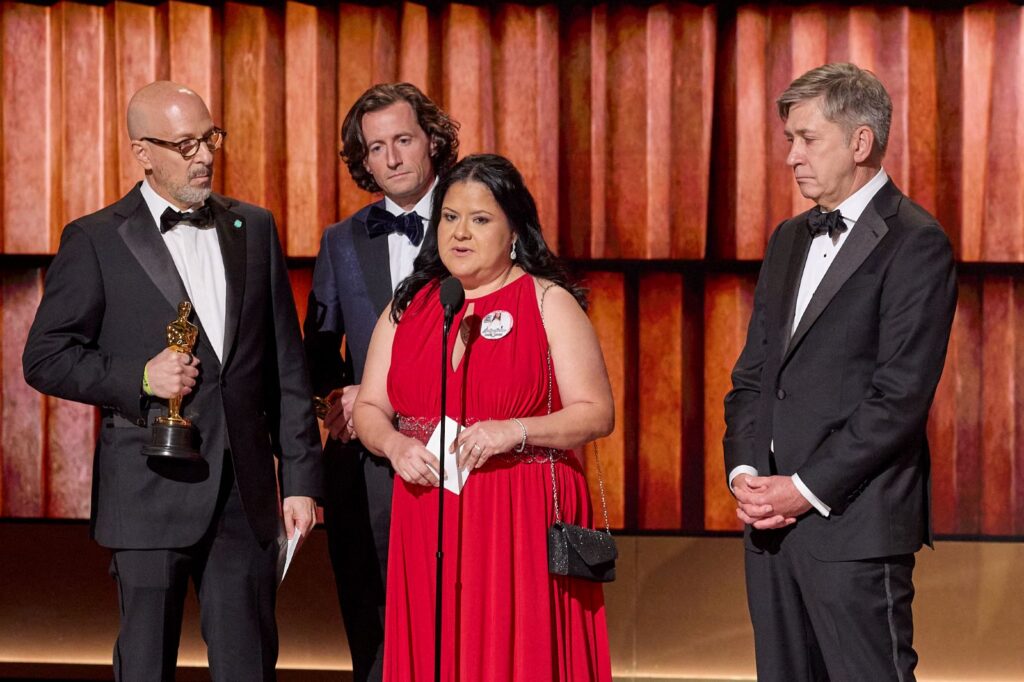
Documentary Winners Inject Political Messages into Oscar Night
Mr. Nobody Against Putin and All the Empty Rooms win Oscars for Best Documentary and Best Documentary Short Film, respectively, while NFB scores its 13th Oscar. .