The Memory Palace: Or, If These Walls Could Talk
How films like Okuirmono, The Nest, and This House explore the histories embedded within the walls of our family homes. .
Home, centuries of folklore have long known, is a site of contradictions. It can be a shelter of comfort and safety where first steps are celebrated in the living room, or a fortress of violence and distrust where harm is committed in secret. Behind walls that offer privacy and protection from intruders, the home can unwittingly enclose its residents with other unwanted guests: shame, grief, trauma, heartbreak, guilt and anger, those feelings that creep into all dimensions of our lives when left unresolved. For many, the reality of home resists the ideal of a stable, loving refuge, though the expectation always looms near.
This is perhaps why the horror genre has readily adopted the setting of the haunted house. Creatures lurk in basement shadows, apparitions emerge in hallways, restless spirits correspond through bathroom mirrors, tracing messages in steam and warnings with blood. Sometimes unsuspecting families enter a space with a troubled past, trespassing the territory of a vengeful ghost, other times a parent carries their suffering into a house with the rest of their belongings. Whether in The Shining (1980) or Presence (2024), horror films intuitively understand that home is vulnerable to forces that threaten the family unit, where fraught histories unravel privately in the present.
Though the phenomenon often conjures imagery of phantoms and ghouls, not all hauntings are supernatural or frightful. Finding its origins in the Old French hanter meaning “to inhabit, frequent” and the Proto-Germanic haimaz meaning “home,” the word “haunt” settles on a more familiar register. How many times have we been haunted by memories, or felt moved by an antique heirloom? When was the last instance you were haunted by a thought, one that compelled you to reconsider a decision or hope for a different future? As Avery Gordon notes in the book Ghostly Matters, “Being haunted draws us affectively, sometimes against our will and always a bit magically, into the structure of a feeling of reality we come to experience, not as cold knowledge, but as a transformative recognition.” In our everyday lives, haunting is an invitation to notice a presence acting on our realities, demanding to be acknowledged and brought into the light.
Over the past few years, documentary has taken up the haunted house, trading jump scares and possessions for research and reenactments in pursuit of insights on the past. A structure that collects and displays personally significant objects, the home serves as a makeshift museum whose artifacts and ephemera can be mined for clues about former inhabitants. Through strategies of speculation and investigation, filmmakers have been inquiring: who took residence here? What do the interiors and objects left behind tell us about how they conducted their lives? In what ways does the past continue to reverberate in the present?
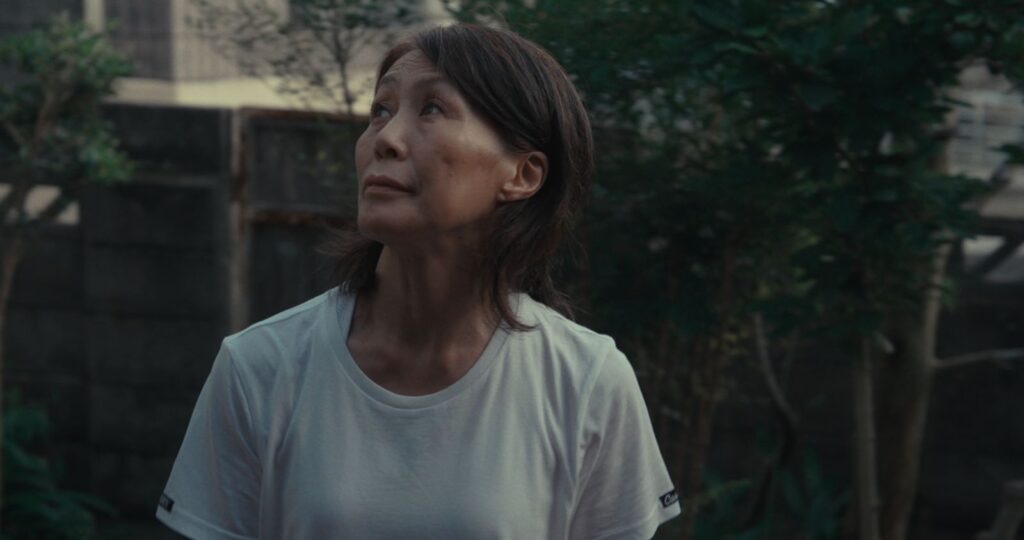
In Okurimono (2024), filmmaker Laurence Lévesque imagines the home as a memory palace. After living in Montreal for 20 years, Noriko Oi returns to Nagasaki to determine the future of her childhood home. Though technically vacant after the passing of her parents, the house is filled with stacks of photo albums, piles of garments and appliances, and boxes of documents that provide evidence of her late mother Mitsuko’s life. A survivor of the 1945 atomic bombing, Mitsuko silently carried the stigma of being exposed to radioactivity, rarely speaking of the tragedy to her children. As Lévesque reveals through testimonies, survivors felt marriage was only possible between other survivors, held guilt over having children, and refused to be officially registered over fear of discrimination. It was not until after her mother’s death that Noriko began to uncover the truth, finding hidden letters in Mitsuko’s cosmetic box that prompted her to dig deeper. “Maybe she wanted to send a message,” she explains to a worker at the Nagasaki National Peace Memorial Hall.
The aged letters, once buried with shame, now present themselves to Noriko after years of concealment to begin a passage of closure that was not possible while Mitsuko was alive. This haunting prompts her to seek other local survivors for their accounts of the bombing, a search for approximations of what her mother always held tight. “You don’t discuss it. It only makes us sad,” one tells her. “It’s as if they’ve sealed up their most painful memories,” a descendant of survivors shares about his grandparents, a sentiment that echoes Mitsuko’s reluctance to talk. As more interviews unfold, it becomes increasingly evident that a spectre has haunted not only our protagonist’s family, but generations of families in the town.
Despite this, Okurimono remains a portrait film, attending to the specificity of Noriko’s experience. We visit various rooms in her childhood home, observing Noriko as she sifts through her mother’s belongings in preparation for the sale of the house. The home, where we carry out our daily lives, can reveal more about a person than what they’re willing to say. This fact is apparent to even a surveyor on a brief tour of the property, who remarks that the house “feels warm and well-loved” during his inspection.
As Noriko clears each chamber of its furnishings, she examines pockets of her mother’s life that were previously sealed. Through letters that were sent to Mitsuko at different addresses, she learns of her mother’s friends, and the relatives who sheltered her after the bombing. On bookshelves, she finds a collection of poetry by Noriko Ibaragi, which contains a composition titled “When I Was at My Most Beautiful.”
Born in the same year as Mitsuko, Ibaragi writes of the devastation that arrived with Japan’s defeat during WWII, sketching a vignette of youth and adolescence marked by death. These details offer the possibility of retracing Mitsuko’s movements and memories decades later, a compromise between disclosing and withholding that acknowledges Noriko’s longing for answers and her mother’s approach to trauma.

By the time the house has been emptied, ready for its new owners, there’s a sense that the haunting has ceased. The letters have fulfilled their mission, surfacing from the past to provide emotional resolution in the present, over 30 years after Mitsuko’s passing. More than a tangible connection to her mother, though, the documents serve as reminders, permanent objects drawn from temporary interiors that recall the importance of remembering, even as the shape of home shifts over time.
In The Nest (2025), collaborators Chase Joynt and Julietta Singh expand on Lévesque’s project of preserving maternal legacies. At the end of her mother’s life, Singh returns to her childhood home in Winnipeg to bring into the light its 140 years of forgotten and unrecorded history as a last farewell. Once a residence that frightened Singh with scenes of violence and the presence of ghosts, the three-storey Victorian mansion now provides comfort as a place that will soon absorb her mother into its lineage of matriarchs. Through a constellation of interviews, newspaper clippings, photographs, and a painting, she patches together a record of former occupants and their communities with varying degrees of details and omissions. An alternative history from the margins, the film gathers fragments to hypothesize how these figures inhabited the house.
The Nest, Chase Joynt & Julietta Singh, provided by the National Film Board of Canada
The first matriarch of the home, Singh tells us, was Annie Bannatyne, a Métis revolutionary who founded Winnipeg’s first hospital. After horsewhipping a man for racist comments, Bannatyne was said to have sparked the 1869 Red River Resistance led by Louis Riel. Following a period of vacancy, the house was reanimated in the early 1890s as a makeshift boarding school after a fire at the Manitoba School for the Deaf. Among the inhabitants was Mary Ettie McDermid, the first Deaf teacher in Manitoba and the wife of the school’s hearing headmaster. In the mid-1960s, the house served as the Consulate-General of Japan, where consul Kumao Okazaki, his wife Hisako, and their daughter Masa resided. Though the family was nearly untraceable in the archives, Singh was moved by the idea of racialized girls and women living in the home prior to her family given the homogeneity of the region.
In locating the house as a radical site of convergence, Joynt and Singh construct a counter narrative that challenges the histories taught in schools, one that omits our nation’s atrocities and discriminatory practices, and the individuals who persisted in spite of them. As Singh notes, “The people we’ve forgotten are often the ones who’ve made the most sustaining impacts. We find these lost ancestors not in the official documents of the nation, but in the private spheres.” Indeed, the film dreams of the home as a reparative portal that can mend gaps in knowledge and carve space to extrapolate stories across time where state and institutional archives cannot.

The Nest, however, departs from other films seeking knowledge in the margins through its investment in spectral registers, taking seriously the presence of ghosts. Of her changed perception after discovering her home’s former tenants, she explains, “The house was becoming infused with the lives of others. The spirits that once scared me became my companions. Where I used to hide and wish for elsewhere, now, I could feel the resonances of other girls across time.” For Singh, the sensation of being haunted is both emotional and intellectual, an invitation to embrace unconventional strategies of communing with the past.
To that end, the film stages séances in the form of reenactments by current day community members. Michif author katherena vermette plays Annie Bannatyne alongside a cast of Red River Métis citizens and a descendant of Bannatyne, who portray members of an organizing committee. In a scene depicting the creation of their school newspaper The Silent Echo, American Sign Language teacher Joanna Hawkins brings to life Mary Ettie McDermid, and students from the Manitoba School for the Deaf in the 21st-century travel back in time to the 19th-century. The actors gather, speak, eat, and laugh, performing acts of confabulation that answer back to Singh’s haunted home. Beyond visual devices that merely mimic ghostliness—like camera movements that float weightlessly as a ghost might—The Nest disrupts the integrity of time by collapsing past and present through embodiment and reincarnation.
Filmmaker Miryam Charles, too, saw the potential of speculative filmmaking, situating her 2022 debut feature This House (Cette Maison) in the hybrid mode. Drawing from the suspicious circumstances surrounding her teenage cousin Terra’s death in 2008, Charles imagines a hazy dreamscape in which a character named Tessa returns from the afterlife after being found hanged in her bedroom in Bridgeport, Connecticut. Now an adult, Tessa reunites with her mother, at last able to provide catharsis. Charles, through Tessa, explains, “What we propose: invented stories, but not so far from reality. An announcement of things to come. We’ll establish the possibility of a fluid journey through time and space, in Haiti, the United States and Quebec.”
Though the title, This House, suggests a single location, a stable conception of a home, there appear to be multiple impossible spaces: the interiors of their Connecticut home with windows facing the verdant landscapes of Haiti, a backdrop setup featuring island scenery in a black void, a free-standing door that opens into an unknown bedroom. Yet, as Tessa repeats, “Anything is possible here.” For Charles, home is a capacious idea that can exist across time and geography, governed by an otherworldly logic.
During one scene, the film cuts between a liminal space and a living room interior where Tessa encounters ornaments on display. Her mother warns against picking them up, cautioning, “You know Haitians and their trinkets. You’re not allowed to touch them. They decorate their houses like museums, with all kinds of trinkets that represent our past lives, our future lives. All of our dreams and those of our children.” Like Okurimono and The Nest, This House understands the home as a private, domestic archive furnished by artifacts; however, the objects here impart something more abstract than memories and clues. Existing in the same spiritual plane of hauntings, these talismans speak to events that have yet to take place, that happened prior to our lifetimes, that we hope to take place.

In resurrecting Tessa, Charles paves a new path out of the unsolved case of her cousin’s rape and murder. The film strictly evades the true crime approach, rejecting the notion that closure must derive from law enforcement or retributive justice. It might instead, the filmmaker argues, arise from granting Tessa the gift of consoling her mother’s grief, celebrating birthdays, and visiting her family’s native land of Haiti, a trip she had always wished to make while she was alive. A quiet but potent intervention, Tessa’s haunting serves as an example for how we might use filmmaking to process the loss of a loved one.
Still, there’s no neat resolution—in Charles’ film, or any occurrence of haunting. To experience a visitation is to feel changed, to retain the knowledge of that which transformed you and allow it to continue enacting upon your reality. It’s uncertain whether Singh will feel newly haunted when her mother eventually departs, or how many lives Noriko will touch at every screening of Lévesque’s film, but what’s undeniable is that something will shift inside us, the theatres, and the homes to which we’ll return. A recognition of the violence that has preceded, haunting, if we choose to listen closely, is an insistence that an alternative future is possible and indeed awaiting.
The post The Memory Palace: Or, If These Walls Could Talk appeared first on POV Magazine.
Related Articles

Visions of the Croisette: The Ultimate Prediction for the 2026 Cannes Film Festival Main Competition
Caught between streaming algorithms and geopolitical upheaval, does cinema’s “sacredness” still matter? A Los Angeles–based team predicts the 22 Palme d’Or contenders for Cannes 2026—from PTA and Östlund to Panahi, Rohrwacher, and beyond.
Exposing the Dark Truth of Digital Totalitarianism: Documentary 'Eyes of the Machine' Arrives in Prague as One World Film Festival Opens
Following its acclaimed premiere at IDFA Amsterdam, investigative documentary Eyes of the Machine screens at One World International Human Rights Documentary Film Festival in Prague, with Uyghur witness Kalbinur Sidik attending in person.
How Twisted Yoga Centres Care Amid a Web of Lies
An interview with Twisted Yoga director Rowan Deacon and executive producer Suzanne Lavery on their true crime doc now streaming on Apple. .